Watching Geneva Lake Freeze: Where the Ice Starts and Who Calls It
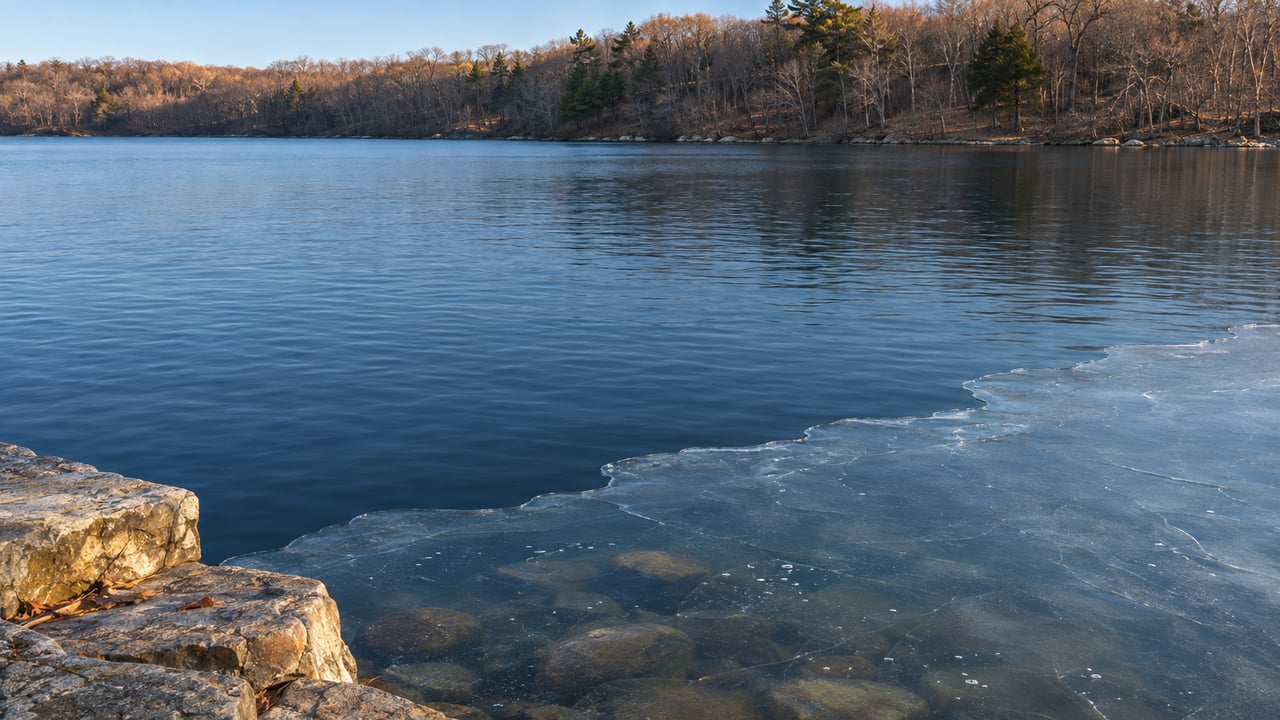
Last winter's first iceboats went out on Lake Como, not Geneva Lake. On December 5, 2025, two BoeCraft Skeeters and about half a dozen Nites were on Como's first ice. A five-inch snowfall chased them off. The snow melted to slush and refroze, and organized racing started on Saturday, December 20, according to the BoeCraft fleet's season report. Geneva Lake was weeks away from that point. In late February, WISN reported iceboats running on "a frozen stretch" of Geneva Lake off Fontana after a rare cold stretch.
That gap is normal. Each winter the area's lakes freeze in roughly the same order, and Geneva Lake comes last. On Geneva Lake itself, the ice that matters for the 160-year record forms last of all, out past the west-end points that most downtown walkers never look toward.
The Geneva Lake Environmental Agency gives the lake's measurements on its Ice-On Contest page. Geneva Lake is 7.6 miles long, has 20.2 miles of shoreline and is 140 feet deep at its deepest point. GLEA calls it the second deepest natural lake in Wisconsin, and on the same page it says the depth means Geneva Lake often takes longer to freeze completely than other lakes nearby.
The iceboaters plan around this. A 2020 profile in At The Lake Magazine explained that Lake Como and Delavan Lake usually freeze earlier in the season because they are smaller and shallower. Early ice has its own risk, which iceboaters call "getting snowed out." An iceboat's runners can push through only a light dusting of snow, and drifts on the ice are dangerous at speed. This means the first ice of a winter can be covered by snow before Geneva Lake has frozen at all.
The 2024–25 season ran in the same order. The BoeCraft fleet opened racing on Delavan Lake in mid-January 2025, and it raced Geneva Lake's east end on February 8 and 9. Both seasons went in the same sequence: Como or Delavan first, then the east end of Geneva Lake, and the rest of the lake later.
Inside Geneva Lake, the freeze follows a direction. A long-term ice dataset in Scientific Data, a Nature journal, describes Geneva Lake as typically freezing from the east end to the west end, with the deepest area of the lake freezing last. For anyone living near downtown Lake Geneva, the water off Library Park and the Riviera can look closed while Fontana still has open water.
The gap can last a whole winter. In a story on the lake's fifth recorded winter without full ice, Kenosha News reported that ice had formed near Geneva Bay and Williams Bay, but the water near Fontana and Conference Point was still open. That winter the lake did not get full ice cover, only the fifth time that had happened in a record going back to 1862. Lake Geneva Regional News ran the same story. Both bays had frozen that winter, but the lake was never recorded as frozen.
The official freeze date comes from one person's routine. The Scientific Data paper identifies Theodore W. Peters as the keeper of Geneva Lake's ice record for the 25 years before its publication. He watches from the west end, not from town. He scans with binoculars from six spots: Conference Point, Cedar Point, George Williams College, the Brookwood Subdivision lakefront, Fontana and the Williams Bay lakefront.
The paper describes the rest of the method too. When conditions call for it, the first look is at about 8 a.m., and some days he checks more than once. Open water is easier to spot after a light snowfall. Ice-on is recorded only after the lake has stayed frozen for two days. Ducks and geese can keep a patch of water open, so up to about five acres of open water full of waterfowl still counts as frozen. Ice-off is recorded when the lake is clear of everything except small plates of ice floating around or washed up on the leeward shore.
Under these rules, a cold night that skins over Williams Bay does not count, and neither does a frozen morning that breaks up by the afternoon. The deep water off the west-end points has to freeze, and the ice has to last for two days.
GLEA's historical range is wide. Since record-keeping began in 1862, Geneva Lake has frozen as early as November 23 and as late as March 10, and GLEA says every date between those two has happened at least once. On GLEA's lake data page, the usual pattern is a freeze around January and ice-off in late March.
As this post goes up on Thursday, November 19, the earliest freeze date on record is four days away. Over 160-plus winters, Geneva Lake has frozen in late November, in mid-winter, deep into March, and in a handful of winters not at all. GLEA plans its school contest around that range. In last year's student Ice-On Contest, classrooms in grades K–8 guessed the date the lake would be completely frozen, and "no freeze" was allowed as an entry.
The iceboaters wait for something different from the record keeper. They need ice they can sail on, and they need it to stay that way through race day. At The Lake Magazine's profile describes Skeeter Ice Boat Club members meeting on winter Wednesdays to talk over the day's conditions, often over lunch, and it names Chuck's Lakeshore Inn in Fontana as a favorite spot.
Their requirements are tight. Longtime member Fritz Button told the magazine that most racing iceboats need ice about 4 inches thick or more, and that "ice checkers" walk the lake ahead of time looking for seams, thin spots and holes. Members told the magazine that wind under 7 or 8 mph is too light and wind over 25 mph is too dangerous. Button also said "it's an unwritten rule to not sail if it's below 10 degrees."
The racing history behind those rules is local. The magazine reports that around 1930, Fontana boatbuilder Walter Beauvais moved the steering to the bow and built a simpler boat with a single 75-square-foot sail, which he called the Beau-Skeeter. In March 1933, a group that included Beauvais met at F. Arthur Andersen's home in Williams Bay and formed the Beau-Skeeter Ice Boat Club. Five years later it was renamed the Skeeter Ice Boat Club. Williams Bay was known as the "Iceboat Center of the World" by at least January 1966, when an ABC's Wide World of Sports crew came to film the Northwest Ice Yachting Association's annual regatta.
Fleet Captain Steve Schalk gave the magazine a figure that shows how much has changed. To award trophies, the club needs at least five races in a series. In recent seasons before that 2020 profile, it had only just managed the minimum, and Schalk said some older members remembered seasons with more than 30 races. Button said that as a child he could sometimes sail on Lake Como before Thanksgiving. Last winter, Como's first sailable ice came on December 5.
Last winter's cold spell was unusual. WISN reported that Milwaukee's average temperature from December 1 through February 10 was 22.1 degrees, the coldest stretch since 2014, and that the cold supported ice across much of southern Wisconsin. Off Fontana in late February, iceboater Richard Stearns described a sudden gust to the station this way: "All of a sudden, out of nowhere, you didn't hit the accelerator; God hit the accelerator."
Even that winter followed the usual pattern. The first ice was on Como in December, and the boats reached Geneva Lake at Fontana by late February. That is the order to expect this winter as well. Ice in Geneva Bay is an early sign, the smaller lakes show whether the season has started, and the official freeze date depends on the west end.
Along the shore, the winter routine starts in the fall, when the piers come out. The neighborhood rinks and sledding hills take over once the cold sets in.
Some owners watch the west end from their own windows every December. If you own one of those shoreline homes and want to know where it stands in today's market, Bob Webster brings more than 40 years of Geneva Lakes market knowledge and would be glad to help. Request a confidential market valuation and we can talk it through quietly before the ice comes in.
Stay up to date on the latest real estate trends.
November 19, 2026
Bob Webster | November 13, 2026
November 12, 2026
November 5, 2026
October 29, 2026
October 22, 2026
October 15, 2026
Bob Webster | October 14, 2026
October 8, 2026
Bob is dedicated to offering the finest real estate service available in the Lake Geneva area. He attempts to make each buyer or seller he works with feel like they are the one and only client he has and strives to make each transaction a pleasurable experience with the least amount of problems, stress, and inconvenience to them.
101 Geneva National Ave. S. Lake Geneva, Wisconsin 53147